
The Seahawks are 5-2. They are tied for first place in the NFC West and the NFC overall. Their record is good enough to be intrigued, but it is hard to know just how excited fans should be. After all, the last time the Seahawks were 5-2 was in Pete Carroll’s last season. That start convinced the coaching staff and front office to add a player named Leonard Williams via trade. He played his first game against a Baltimore Ravens team that had young defensive coordinator, Mike Macdonald, that befuddled Seattle so much in a 37-3 defeat that John Schneider would eventually hire him as the team’s new head coach a couple of months later. That 2023 team never really recovered. They lost five of six after that 5-2 start, and ended the season 9-8, and in 3rd place in the division. Williams and Macdonald are central figures in this version of the Seahawks. Let’s take a look at how this group compares to some of the other Seahawks teams that won at least five of their first seven games.
The 2023 Seahawks
- Started: 5-2
- Finished: 9-8, 3rd NFC West
- Playoffs: No
The following table compares some key statistics for both teams after seven games:

This season started with a brutal 30-13 home opening loss to the Rams, where the Seahawks were leading at halftime, but lost both their starting tackles on offense and were outscored 23-0 in the second half. They miraculously turned around and beat a Detroit Lions team that had won in Kansas City against the Chiefs in Week 1. A relatively close win at home against Andy Dalton and the Panthers led into Devon Witherspoon’s coming out party on Monday Night Football against the Giants. His pick-six in that game remains his only interception in the NFL.
Headed into their Week 5 bye week, the offense looked strong after scoring 37 points twice. They would not score that many points again that season. Trying to get by with Jake Curhan at right tackle was not a workable option as he gave up pressure-after-pressure versus the Bengals, leading to a 17-13 loss. Wins at home against the Cardinals with Josh Dobbs at quarterback and the Browns with PJ Walker at quarterback got them to 5-2.
It is easy to see in retrospect that their record was built on a very shaky foundation. Abe Lucas was out until Week 13, and Charles Cross missed a few games. Uchenna Nwosu was lost for the year in Week 8 versus the Browns (what is it about him and that team?), and the run defense never recovered from his absence.
Seattle held 3 of the first 5 opponents under 100 yards rushing. Just two of their last 12 opponents failed to break the century mark, while a whopping 9 of 12 rushed for over 135 yards. The final two teams both went over 200 yards on the ground.
Poor Williams joined the team before they got their tails spanked by the Macdonald Ravens, and it did not get much better after that.
They went from allowing 4.8 yards per play through seven games to a humiliating 6.0 the rest of the way, ranking 30th in the NFL. Opponents scored 26.4 points per game over that span, 29th in the NFL. The pass rush disappeared as well.
They had the same number of sacks (23) as the 2025 squad in their first seven games (3.3 per game), but that dipped to 2.1 per game over their final ten contests, 27th in the NFL. They could not stop the run. They could not rush the passer. The hopelessness peaked when they dropped a home game to Mason Rudolph and the Steelers while a playoff berth was still a possibility.
Carroll would be let go after the season.
There is very little in common between these two teams besides their records. Besides the different coaches, schemes, and styles of play, that 2023 team was injured and facing a division that included a powerhouse 49ers team that would reach the Super Bowl. The final victory came when the Cardinals appeared to intentionally miss two field goals in order to preserve their draft spot, which resulted in drafting Marvin Harrison Jr. while Seattle would drop to the 16th spot where they took Byron Murphy II.
The 2020 Seahawks
- Started: 6-1
- Finished: 12-4, 1st NFC West
- Playoffs: Yes, Lost 30-20 in Wild Card to Rams
Comparison after seven games:

This was the last Seahawks team to win a division title. They were undefeated in their first five games, and tied for the franchise-best 6-1 record through seven games. Led by offensive coordinator Brian Schottenheimer, the offense took off at a breakneck speed behind the “Let Russ Cook” movement. Russell Wilson threw an astounding 26 of his career-high 40 passing touchdowns in the first seven games. The next-closest quarterback was Aaron Rodgers with 20 touchdowns.
Seattle was 3rd in EPA/play (0.196), 3rd in success rate (50.5%), and 4th in dropback EPA (0.277). The current Seahawks offense ranks 14th in EPA/play (0.035), 15th in success rate (44.8%), and 9th in dropback EPA (0.219).
The 2020 squad easily sets the record for most points scored through seven games. The second place team was in 1987 and scored 46 points fewer.
They scored 38 points in the opener, and scored more than 30 points in each of their first four games. In fact, they only had one game under 30 points in their first seven, and they still scored 27 in that one. There was a reason they were the #1 DVOA offense in football through seven games.
Part of the success was a quality offensive line that had Duane Brown at left tackle, Damien Lewis at left guard, Ethan Pocic at center, and Brandon Shell at right tackle. The weak spot was right guard where Mike Iupati struggled to stay healthy and Jordan Simmons just struggled.
Their only loss was a Sunday Night game in Arizona, when they fell 37-34 in overtime to a Kyler Murray-led Cardinals team that saw him post 3 passing touchdowns, 1 rushing touchdown and 427 total yards. Wilson had more. His 474 yards and 3 passing touchdowns were wild, with all three going to Tyler Lockett, who put up 200 yards receiving on 15 catches in addition to those scores. Wilson threw an uncharacteristic 3 interceptions. That, plus an anemic defense cost the team an undefeated seven game start.
As hot as the offense was going, the defense was yielding yards and points at a dizzying pace. The 199 points allowed was the 2nd-most in team history to that point. Only the expansion 1976 squad allowed more (204).
The pass rush was so bad (12 sacks, 1.7/game) that Seattle traded for Carlos Dunlap from the Bengals. He contributed 5.0 sacks the rest of the way, but it was not nearly enough. This was the Jamal Adams maiden voyage, where he put up 9.5 sacks to lead the team as a safety.
No Seahawks offense had averaged more yards per play, but there had also never been a Seahawks defense to allow more yards per play.
When Wilson started to cool over the last part of the season, the defense improved considerably. The offense went from averaging over 34 points per game to only scoring 34+ once in their last ten games. They 23 or fewer in five of those games. The defense held the final eight opponents to 23 points or fewer, allowing the team to win six of nine and win 12 games.
They hosted the Rams in the playoffs and could not beat Jared Goff (injured) and John Wolford. The defense surrendered 131 yards on the ground to Cam Akers, and some guy named Cooper Kupp put up 78 yards receiving.
Wilson wilted, going 11 for 27 for 174 yards, throwing a pick six, and getting sacked 5 times. D.K. Metcalf caught two touchdowns, and Chris Carson rushed for 77 yards on 16 carries, but the game was not close. The Rams built a 30-13 lead before a late Seahawks touchdown led to the final 30-20 score.
This was a team that felt like it could be the best in the NFL. The offense was blazing hot, and people had not yet soured on Adams. The defense became a league-average unit, but there was very little to offer on the defensive line. L.J. Collier and Benson Mayowa got considerable snaps. Damon “Snacks” Harrison was brought in to try and help. Shaquem Griffin saw som snaps, as did his brother, Shaquill. Weak spots like Tre Flowers and Ugo Amadi were hard to hide when the defensive line was also weak.
They dropped back-to-back games against the Bills and the Rams, but it was the 17-12 home loss to Colt McCoy and the Giants that really established their floor.
There are some similarities with this 2025 squad. The 2020 group had an elite offense and a top-ranked special teams. The 2025 squad has an elite defense and a top-ranked special teams. Both quarterbacks had the best starts of their careers. Where the teams diverge is that the 2025 version does not have the same clear weak unit or glaring talent gaps that the 2020 team did. The offense may be 7th in DVOA, but the 2020 defense was 19th and never rose higher than 15th.
Wilson’s 2020 season is a good reminder that even the hottest quarterback play can cool off as the season wears on. This current offense does not have an offensive line that is playing quite as well as that 2020 group, especially when factoring in the run game with Carson.
The failure of this all-in on Wilson approach was the beginning of the end for his tenure in Seattle. He would play one more unremarkable season before being trade to Denver.
Should Darnold and the pass game slow down, there is a real chance this team will score fewer points the rest of the way, just like the 2020 squad. This defense feels better equipped to weather that storm, and the hope would be that this young line would improve in run blocking to help ease the burden on the quarterback.
The 2019 Seahawks
- Started: 5-2
- Finished: 11-5, 2nd in NFC West
- Playoffs: Yes, Lost in Division Round to Green Bay, 28-23
After seven games:

This was one of the most bizarre seasons in recent Seahawks history. It was the last time they won a playoff game. Josh Gordon was on the team. Jadeveon Clowney had his one season in Seattle. Marshawn Lynch and Robert Turbin returned out of retirement after every running back from Chris Carson to Rashaad Penny to C.J. Prosise to Travis Homer all got injured. Bradley McDougald patrolled the safety spot with a combination of Tedric Thompson and Lano Hill before the team traded for Quandre Diggs. Guys like Branden Jackson and Mychal Kendricks were getting significant reps on defense. And John Ursua cost the team a division title against the 49ers.
The offense came out strong this year. They scored 27+ points in five of their first six games, going 5-1, before getting humbled against the Ravens (30-16) like the 2023 squad.
This was one of Wilson’s more efficient years with 31 touchdowns and just 5 interceptions. He was, however, sacked a league-leading 48 times.
Carson was a huge part of the offense, rushing for a career-high 1,230 yards in just 15 games. This was kind of the last Carroll-oriented offense. They ran for 100+ yards in 13 straight games, and over 140 yards nine times.
Their offense was far more balanced than what the 2025 Seahawks have demonstrated so far. Injury was their undoing, as was a defense bereft of talent and scheme.
Clowney had one of the most dominant single defenses performances in Seahawks history when he helped the team win against the 49ers in San Francisco, but he was unable to replicate that, and had trouble staying on the field the rest of the way.
That left the defensive line to players like Rasheem Green and Quinton Jefferson. Jarran Reed, Poona Ford, and Al Woods added value, but they ranked 30th in rushing yards allowed and 28th in yards per attempt. The pass defense was not a whole lot better, ranking 27th in passing yards allowed.
Special teams was also a problem with Jason Myers missing 5 field goals and 4 extra points.
This was a relatively well-constructed offense that might have led Seattle to a division title and more playoff success had they remained healthy. The defense was not good, though, and put a hard ceiling on their overall potential.
The 2025 squad would certainly love to have the running game from that team, and Wilson was operating at a high level, but the flaws were clear even at this point in the season back then, and were more glaring than anything on this current team.
The 2017 Seahawks
- Started: 5-2
- Finished: 9-7, 2nd in NFC West
- Playoffs: No
After seven games:

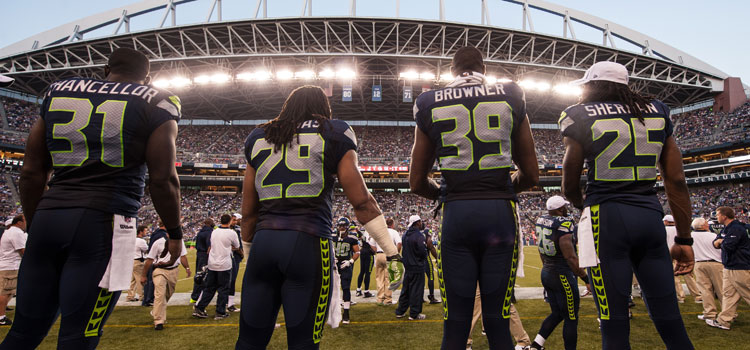
This is a rough one. It was the beginning of the end for the Legion of Boom. Both Kam Chancellor and Richard Sherman played their last games as a Seahawk. So did Jeremy Lane and Byron Maxwell and Michael Bennett and Cliff Avril. Earl Thomas would play part of one more year. Doug Baldwin Jr. retired after the next season. Not that Jimmy Graham belongs in the LOB era, but this was his last season in Seattle as well. Even Jon Ryan was gone after this year.
There were also some oddities like Dwight Freeney and Eddie Lacy on the roster. This was the Luke Joeckel, Rees Odhiambo, Oday Aboushi, and Matt Tobin era on the offensive line. It was going so poorly at left tackle that the team traded for Duane Brown after Week 8 to stabilize things just a little.
That was the second big trade of this season as the 2017 draft will likely go down as the worst in the John Schneider era. Malik McDowell was their top pick after trading down multiple times, and his career never got started due to an ATV accident. That led Seattle to make a splash to get Sheldon Richardson from the Jets. He was a fine player, but not an impact player.
This was still a defense-oriented team, but the cracks were starting to form. The memorable 41-38 shootout against Deshaun Watson and the Texans was a glimpse at the future of Let Russ Cook. That win got them to 5-2 after a 2-2 start. Two games later, the fateful game in Arizona was as costly as a win could be as Sherman and Chancellor were both lost for the season.
The defense struggled. The offense could not lift the team and ultimately collapsed in late games agains the Rams and Cowboys where they had fewer than 150 yards of total offense in both contests. The 42-7 loss to the Rams marked the true turning of the tide in the NFC West as Sean McVay ascended and Carroll started to regress. This would ultimately end a streak of five straight playoff appearances for Carroll and the Seahawks.
This was an aging team that desperately needed young talent to step forward and supplant some of the stars who were approaching or past 30-years-old. Frank Clark was one of the only guys to do it, as he had 9.0 sacks this season.
Once the injuries hit on defense, there was not enough talent there to hold up. Without the defense leading the way, the offense was unable to carry the load, especially the awful offensive line.
The team limped to a 3-3 finish after the Cardinals game, with that Rams loss putting a period on the end of LOB era.
The 2025 team seems quite different. That 2017 group was in transition. Not only did their draft face plant, but the veterans saw their careers end quickly. The current team is one of the youngest teams in the NFL based on the ages of people getting snaps. There are some veterans mixed in that are massive contributors, but some of the future stewards of those positions are also stepping up.
Look at Leonard Williams and Byron Murphy II, for example. This draft, and the past few, have infused the roster with a ton of young talent that is rising instead of falling. There was nobody like Jaxon Smith-Njigba breaking out on the 2017 team unless you want to stretch and put Clark in that category.
The script of season was a little similar. They both started with frustrating losses to NFC powers (17-9 @ GB), and had an early home blowout against a weak opponent (46-18 vs IND). Most of the games were close, but it was hard to find anything truly special about the 2017 squad. Their middling DVOA across the board tells the story.
The 2013 Seahawks
- Started: 6-1
- Finished: 13-3, 1st in NFC West
- Playoffs: Yes, Won Super Bowl
After seven games:

Everyone certainly remembers this crew. Their only loss in the first seven games was in Indianapolis against Andrew Luck by six points. They had beat the 49ers 29-3 at home, the Jaguars 45-17, and made a miraculous comeback against the Texans 23-20 in overtime.
Many will have forgotten that even that peak LOB defense have up 476 yards to that Texans team that was coached by Gary Kubiak, had Rick Dennison as the offensive coordinator, and John Benton as the offensive line coach.
Houston was hammering the Seahawks in the first half before everything turned.
The Colts scored 34 points, but there were some real flukes on special teams and turnovers that fueled those numbers. They only had 317 yards offense.
This was the best defense of the era, and in the conversation for the best to ever take the field. They were young. They were brash, and nobody, not even Tom Brady or Peyton Manning or Drew Brees, could take them down.
The youth, though, did show up at times. They fell behind 21-0 to an 0-7 Tampa Bay team before roaring back and winning 27-24 in overtime.
There were also many more injuries than people remember. Russell Okung missed eight games. Breno Giacomini eight as well. Sidney Rice went on IR before that Tampa game, and was lost for the season. Big trade acquisition, Percy Harvin, was out until the final three games of the season. Max Unger missed three games. Brandon Browner missed six games. Even K.J. Wright missed four games late in the season.
The pass protection and overall play of the offensive line was awful at times. The collective toughness of the roster refused to let that cost them wins.
The division was fierce that year. San Francisco was coming off a Super Bowl appearance and the Carson Palmer-led Cardinals won 10 games, including a late one in Seattle.
All of those obstacles hardened that team. When it came time to face one of the toughest playoff gauntlets you will ever see, they were ready for the challenge. They had to beat Brees, the 49ers, and then Manning in succession. Some would be surprised to hear that defense was most challenged by the Saints, who put up 409 yards of offense. The 49ers and Broncos barely cleared 300 yards.
That team went into the season as clear Super Bowl contenders. They had been the best defense in a variety of metrics for two years already. Wilson had come into his own as the quarterback of the offense in his second season and Marshawn Lynch was the tone setter for it all.
Where there are some similarities with the 2025 team is that the scheme Carroll employed back then, along with the way he deployed players with unique talents, was novel. The league had not figured out how to counter it. Macdonald is not quite to that level, but his scheme is the one everyone is trying to replicate across the league, and his deployment of players like Nick Emmanwori and Witherspoon could confound a number of offenses.
As good as that defense was at every level, they were most talented in the secondary, the linebackers and the edges. This interior defensive line for the Seahawks is where things start. Williams and Murphy would get reps on that LOB team, as would DeMarcus Lawrence and Uchenna Nwosu.
Comparing any defense to that 2013 group is pointless. There is not a lot of evidence to suggest Macdonald’s crew is on the path to being a generational defense. It is interesting, though, to see that this year’s Seahawks are #1 in overall DVOA (versus #2 for the 2013 squad through seven games) and #2 in defensive DVOA.
That 2013 team finished as the top DVOA team overall, 10th on offense, 1st on defense, and 5th on special teams. The 2025 group is doing better holistically, even if you cannot point to Hall of Fame players are multiple positions.
Getting away from the numbers and the roster, one of the biggest characteristic differences between these teams is just how tough they were in every aspect of the game. The 2025 team is certainly that on defense, but the run game on offense is not close to being physical.
On the flip side, there was no receiver on the Seattle team that was as feared as JSN has become. Baldwin and Golden Tate and Jermaine Kearse were excellent and underrated. JSN is the best player at his position in the sport, and may break receiving records this year.
The point differential and point allowed per game show the difference between these teams statistically. The DVOA similarities are encouraging relative to the rest of the league. Remember, those are based on the league. You only need to be better than the teams this season, even if you are not better than previous renditions.
The 2005 Seahawks
- Started: 5-2
- Finished: 13-3, 1st in NFC West
- Playoffs: Yes, Lost in Super Bowl
After seven games:

Most fans will remember this team as well. Most, just because some are too young to have watched this team closely. It is almost the forgotten Super Bowl team even though it was the franchise’s first. This was also the most controversial and disappointing Super Bowl until…well…it wasn’t.
This team was built around it’s offensive line and offense. The run game was spectacular and largely unstoppable. The pass game was efficient and complimentary without many high octane weapons. A strong rookie class that included Lofa Tatupu and Marcus Tubbs helped this group be good enough to separate from opponents. They were a bend-don’t-break unit that led the NFL in red zone defense. That helped them finish 7th in points allowed even though they were 16th in yards allowed and 16th in DVOA.
They had one of only three non-QBs to win the MVP award since 2001 (LaDainian Tomlinson and Adrian Peterson were the others). Yet, almost nobody who watched that team thought Shaun Alexander was their most valuable player. He might not have been in the Top 3.
Walter Jones and Steve Hutchinson are Hall of Famers. Matt Hasselbeck was the leader and made the whole thing work on offense. Alexander was excellent. The team, though, showed they could win without him when he left the first playoff game with a concussion and they found a way to notch the franchise’s first playoff win in 21 years. That’s right. They had not won a playoff game since 1984 before this team finally ended the drought.
Their season started with a thud when they went into Jacksonville and dropped a 26-14 game against an inferior Jags team. They were only 2-2 after losing in Washington. They would then rattle off 11 straight victories before resting their starters in the final game of the season and losing to the Packers.
A key difference between these teams was just how horrid the NFC West was that year. No other team won more than six games that season. The 49ers were 4-12. The Cardinals were 5-11. The Rams were 6-10. It was a historically bad division. Now, the Seahawks greatness played some role in it, but those teams were all bad.
Obviously, the disparity in the rushing offense is stark as well. The pass protection was also terrific.
Interestingly, you have to add a decimal to find a difference in the yards per play on offense and defense, and the 2025 group is ahead on both (through seven games). It is also surprising that it was the 2005 defense that was outperforming the 2025 group, at least in points allowed. DVOA correctly see the 2025 as much better, relative to the league.
There was some adversity that season as starting safety Ken Hamlin was lost for the year in an off-field incident, and Marquand Manuel had to step in. That worked out better than anyone could have hoped until Manuel got hurt in the Super Bowl and Etric Pruitt bungled away multiple touchdowns.
The 2005 team had a very easy schedule even outside the division. The Eagles and Titans were awful, and when they faced the powerhouse Colts, Manning got injured and Jim Sorgi was brought in to play QB. Their path to the Super Bowl was pretty easy as well, with the Panthers knocking off better teams to setup a pushover in the NFC Championship. Even the Steelers were the Wild Card team from the AFC and were not as good as Seattle. Many thing conspired in that game to cost Seattle their first ring.
One could argue these two teams are alike, with the 2025 squad having a top-ranked defense and the 2005 squad having a top-ranked offense. The current group does not have anything as dominant as the 2005 running game. Their run defense might be closest.
The 2025 team is more talented across the board, even if their blue chip players are not quite as exceptional as someone like Jones or Hutchinson. Williams might approach Hutchinson’s level, depending on how the rest of the season unfolds.
The 2003 Seahawks
- Started: 5-2
- Finished: 10-6, 2nd in NFC West
- Playoffs: Yes, Lost in Wild Card to Packers, 33-27 (OT)

We won’t go deep on this one. Notable with this team was that they had not yet ascended to Super Bowl contenders, but this was the season when they started to believe they could. Hasselbeck uttered his famous, “We’ll take the ball, and we’re gonna score” statement for the overtime coin toss in Green Bay before Alex Bannister ran the wrong route and cost the team an Al Harris pick-six to end the season.
The beginning of a dominant offense was formed this year with that offensive line and Alexander and the receiving duo of Darrell Jackson and Koren Robinson.
The defense was scrappy with 33-year-old Chad Brown and 36-year-old John Randle complimented by rookies Marcus Trufant and Ken Hamlin, but they did not have enough juice to hold up across the season. They were as high as 5th in defensive DVOA after Week 4, but dropped as low as 24th, before finishing 18th.
There is simply no comparison between the quality of that defense with the 2025 Seahawks offense when looking at the lesser unit of both teams. This Seahawks offense is one of the best in football and has rising talent at a number of positions while being extremely young. That 2003 defense was aging and flawed.
Best comparison
Looking back on these 5+ win teams through 7 games shows just how different two teams can be with the same record at the same point in the season. The good news is the worst of these teams (2023, 2017) have very little in common with the 2025 Seahawks. Those were teams at the end. This team very much feels in the formative stage.
In that regard, there is more in common with the 2003 team that was building toward an eventual Super Bowl run a few years later. The difference is this Seahawks team is not missing nearly as many pieces as that team was.
The surprise might be just how favorably Macdonld’s team holds up when compared to the best of these teams. It’s not clear that the 2005 team is a better team than this one. Their strongest strength (offensive line, run game) is stronger than Macdonald’s teams best strength, but the overall roster and level of play is better this season.
Health played a key role in many of these seasons, and will for this crew as well. They have already weathered key injuries on the way to building a 5-2 start. In that way, they are similar to the 2013 team. That group got healthy late and put everything together.
From a point differential perspective, only the 2013 group was better at this point. Not included were the 1984, 1986, and 1987 teams that all had better point differentials as well. Still, it is significant that this team is toward the best in franchise history in that regard so far, and it frankly should be better.
It is worth wondering if the passing offense and overall scoring shares some regression potential the way the 2020 crew did. Darnold and JSN are white hot. The total lack of run game leaves them vulnerable if a team figures out how to slow the early down play action passing. Then again, the run game may benefit once defenses try to take away the pass.
Defensively, this Seahawks team has every reason to think they might get better as the year goes along. They will get healthier after the bye week and have only played 4 total snaps with their starting secondary. There is a chance this becomes the best single side of the ball in the NFL. That can open up a lot of doors.
Whether this team has what it takes to challenge for a Super Bowl will come down to how well this offense can play, and likely how much improvement they can squeeze out of the run game.
From a talent and performance perspective, the 2005 team might be the best comparison. There was a far easier division for that team to feast on, but this defense could belong in the conversation with that offense depending on where things finish.
Seattle has one of the toughest remaining schedules in the NFL. One thing is sure: this team will be battle-tested by the time the playoffs come around. Should they prove their mettle, there may be nobody capable of stopping them.