
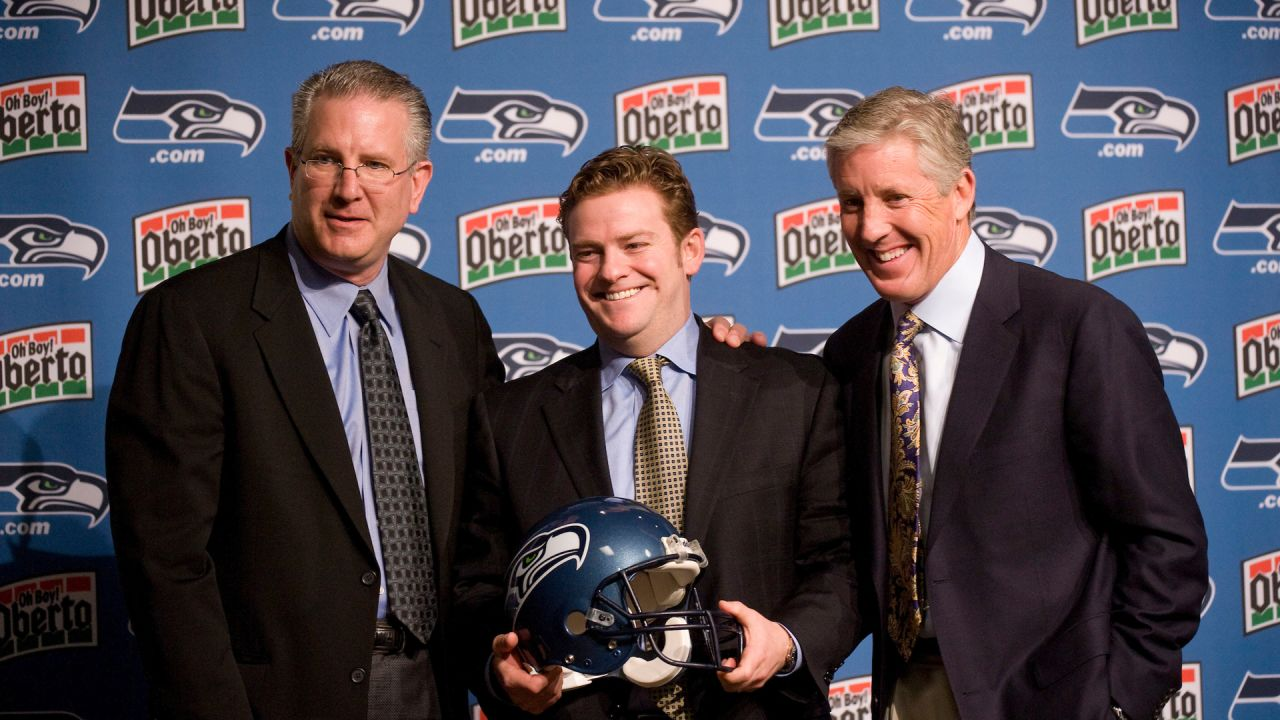
The room was overflowing. Players mixed with reporters, team staffers, and family members as they waited for confirmation of news they already knew. Pete Carroll strode onto the stage with the same pep that had made him a championship-winning coach and a beloved figure by all who crossed his path. His time as head coach and leader of football operations was ending. Tears flowed as he thanked his wife, Glenna, for her support through the years before politely answering questions. He closed by offering his support and a friendly warning to John Schneider, his longtime Seahawks partner, and the man tasked with following a legend:
“It has been 14 years that he’s been sitting there waiting for his opportunity, and he deserves it. He’s great at what he does, and now he’s going to find out,” Carroll paused for effect and grinned at Schneider as he reiterated, “You’re gonna find out, big fella.”
With that, the man who got most of the credit and blame for the past 14 years of Seahawks football exited the stage and ended an era. Air cover, gone. Spotlight, on. Schneider became the final word on football operations for the first time in his career. He would be tasked with not only filling the shoes of one of the most popular figures in franchise history, but turning around a football team that was going in the wrong direction.
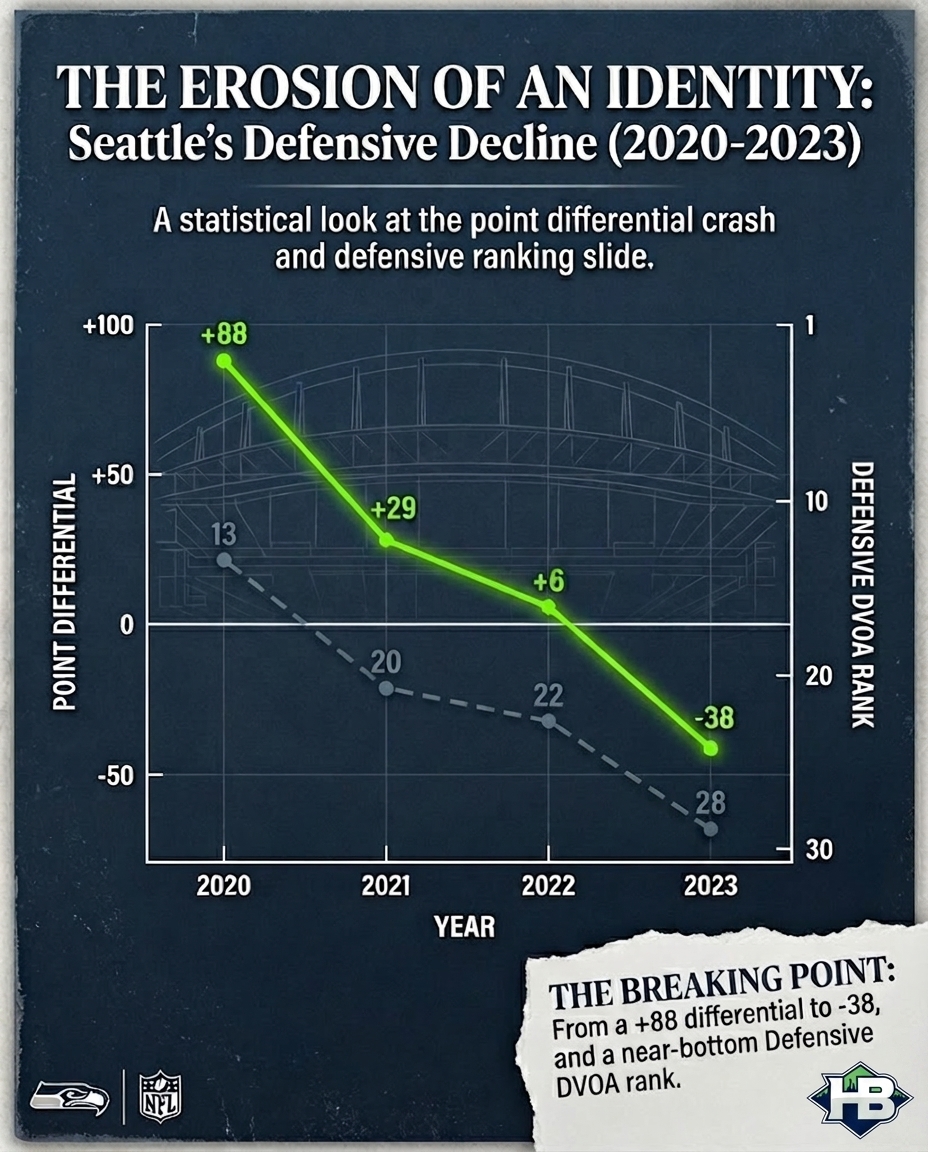
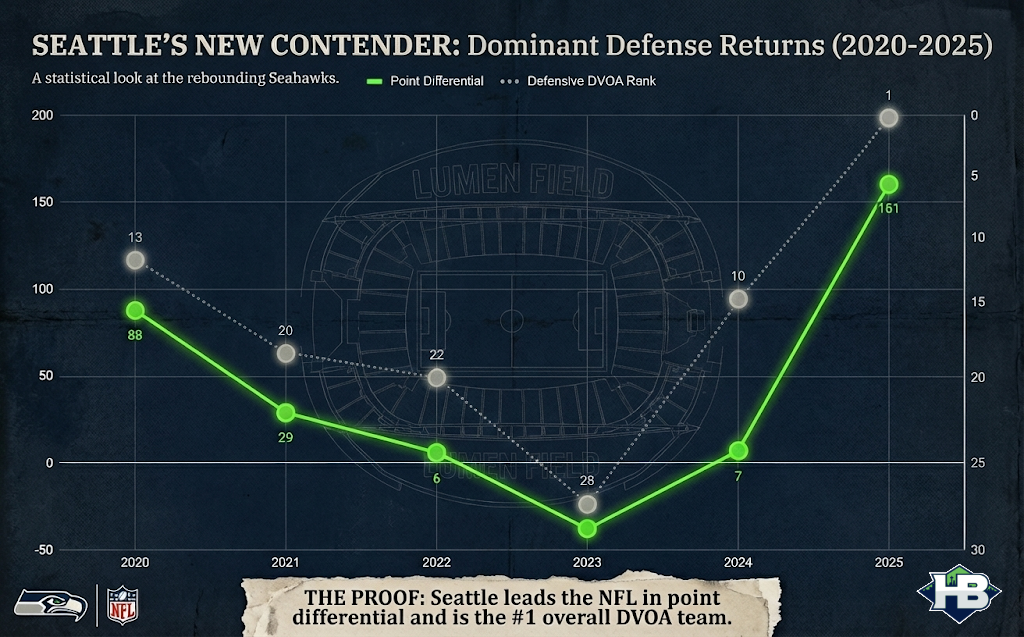
A team that had made its mark with a historically dominant defense was having trouble stopping anyone. The offensive and defensive lines were a mess. The roster had a number of aging and costly vets. Seattle had not won a playoff game in five years, and had the 5th-longest conference championship drought in the NFC. Two years later, Seattle leads the NFL in point differential with a 10-3 record, and Schneider is the favorite to be named NFL Executive of the Year. This is the story of how it happened.
John Schneider had the notes ready for fourteen years.
From his early days in Green Bay alongside Mike Holmgren and Andy Reid, to his time in Kansas City with Marty Schottenheimer, Schneider had been quietly compiling a profile of the perfect head coach. When Pete Carroll departed, the expectation was that Schneider would finally open that notebook and make the safe play: hire old friend Dan Quinn or follow the NFL’s current obsession and grab an offensive guru to nurture a quarterback.
But Schneider has never played it safe. This is the executive who drafted 5’10” quarterbacks when the league wanted height, and helped build the Legion of Boom with oversized corners when the league wanted speed. Convention has never been a barrier to talent for John Schneider; usually, it’s just noise he ignores.
So, while the Titans, Panthers, and Falcons rushed to interview Mike Macdonald in the early window—only to pass on him for offensive stability or familiar faces—Schneider waited.
He didn’t view the delay as a disadvantage; he viewed it as due diligence. Seattle missed the early interview window partly to ensure the candidate met a broader cross-section of the organization, a process that required extensive diversity training for the staff.
“It spoke to John’s humility,” said Assistant GM Nolan Teasley. “He wanted to incorporate everybody… to ultimately make the best decision.”
While Schneider waited, his network went to work. Titans executive Chad Brinker and Falcons GM Rich McKay signaled back a consistent message regarding Macdonald: He crushed the interview.
When the hiring window finally opened for playoff coaches, the Seahawks contingent—including owner Jody Allen—flew to Detroit first. The target was Lions OC Ben Johnson, the hottest name on the market. But after that meeting, the group knew they still had to see the young defensive coordinator from Baltimore.
It was a meeting that changed the franchise’s trajectory.
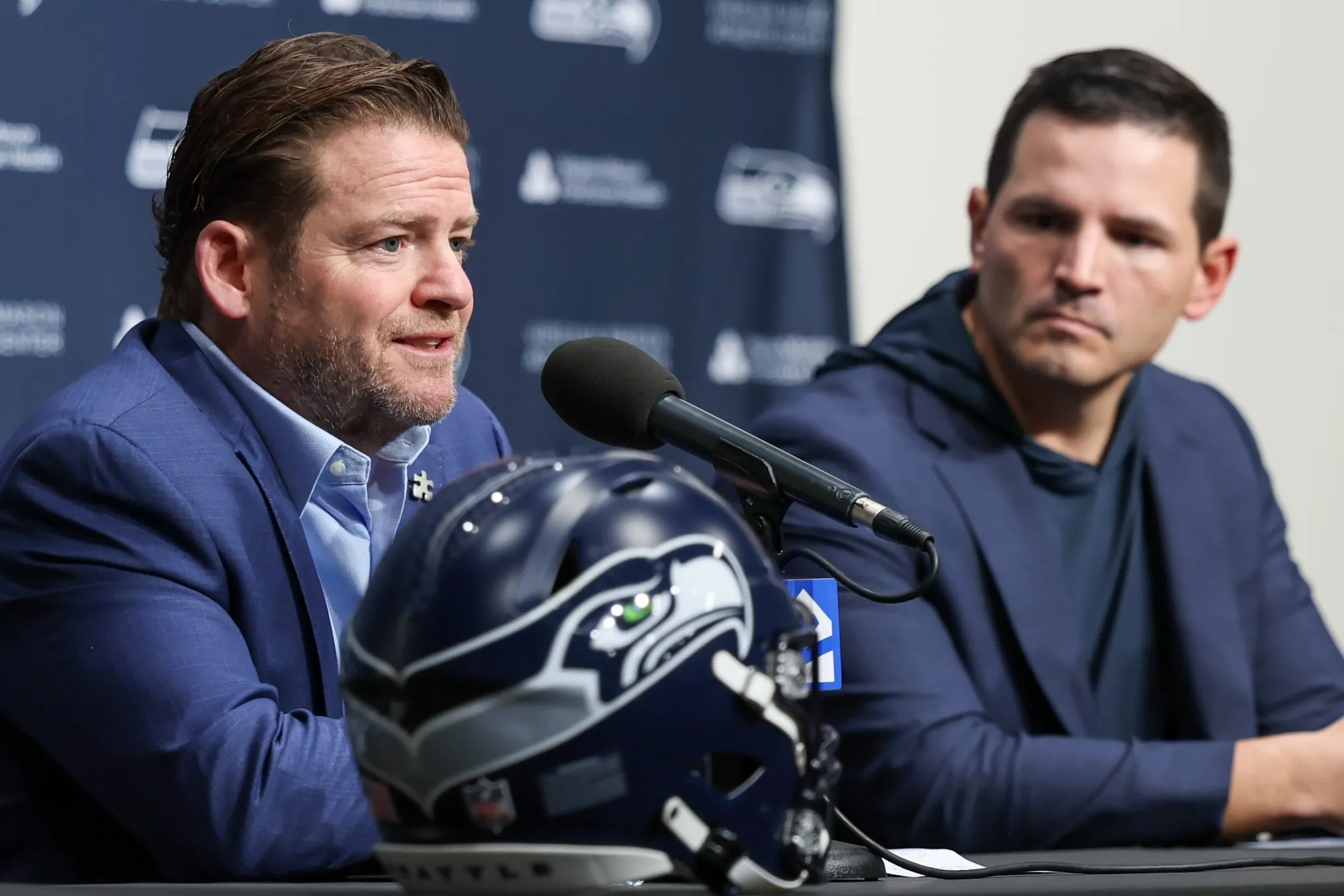
Seattle Seahawks Leadership Evolution
Drag the slider to compare the changing faces of Seahawks leadership
The conversation with Macdonald didn’t just go well; it was electric. Hours “felt like minutes.” In Macdonald, Schneider didn’t just find a coach; he found a partner who shared his vision. He bypassed the flashy offensive options and the familiar to hire a man who had never been a head coach before, and would become the league’s youngest.
The gamble has paid off.
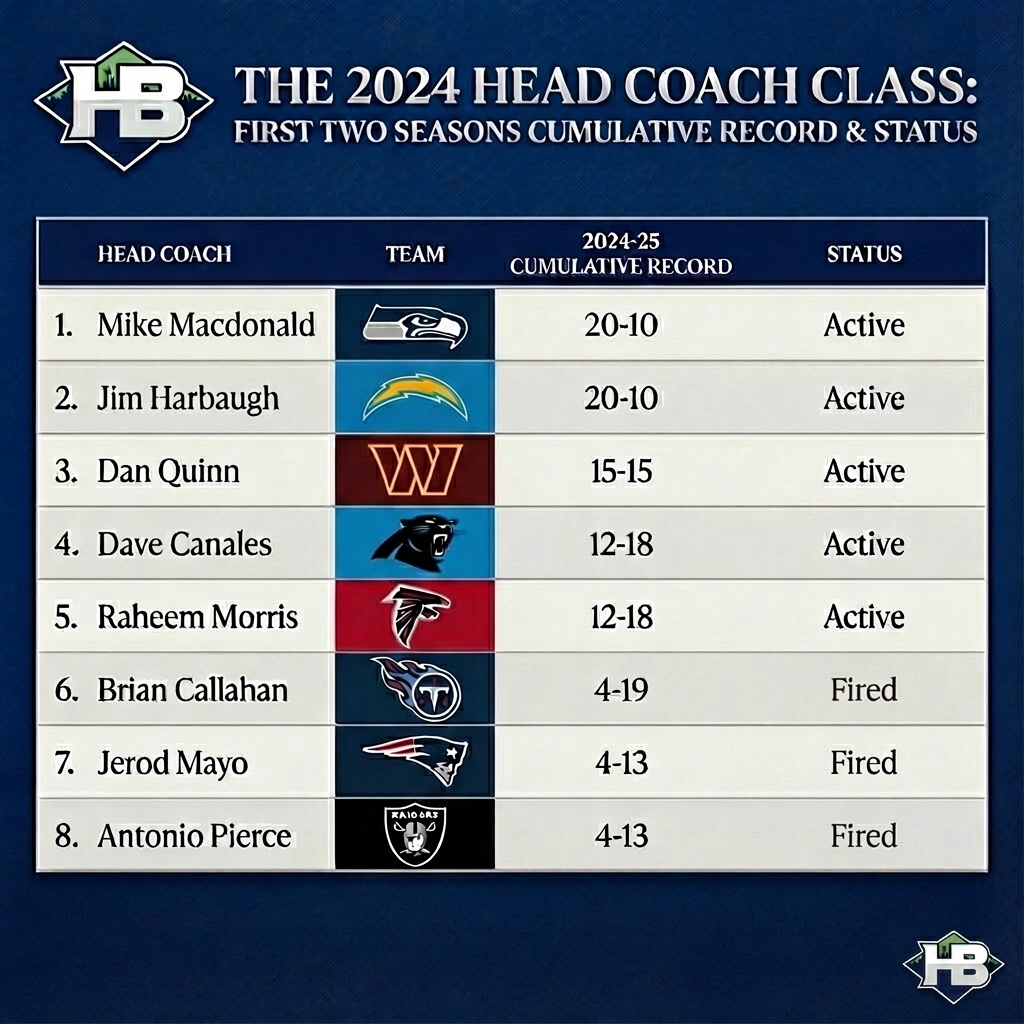
Macdonald is now the first coach in Seahawks history to win 10 games in each of his first two seasons. Perhaps most impressive is the grit the team shows away from home: Macdonald is 13-2 on the road and has yet to drop a dreaded 10 AM kickoff, exorcising a demon that has haunted Seattle for decades.
While fellow 2024 hires like Dan Quinn and Jim Harbaugh found early success, Macdonald has elevated Seattle to a different tier. This season, his Seahawks dismantled Quinn’s Commanders and Morris’s Falcons by a combined score of 75-23.
Schneider may have waited fourteen years to make his first coaching hire, but looking at the standings today, it is clear: Macdonald was worth the wait.
For over a decade, the identity of the Seattle Seahawks was synonymous with noise. It was the brash swagger of the Legion of Boom, the relentless energy of Carroll, and a stadium that registered on seismographs. But as the franchise turned the page to a new era, the culture began to shift. The noise didn’t disappear, but the frequency changed. The current Seahawks locker room is less about bravado and more about a quiet, lethal cohesion.
It is a culture that mirrors the man who has been there all along, operating in the background: Schneider.
Schneider’s leadership style is antithetical to the ego-driven nature of the NFL. He is governed by a midwestern work ethic and a profound humility. “Plan. Communicate. Work. And then we are going to outwork people,” Schneider says of his philosophy on the Finding Mastery podcast. “Nobody is smarter than anybody else. If you feel like you’re smarter than anyone else, you and I are going to have a big problem working together.”
This humility filters down from the front office to the field. Where the Carroll era was defined by loud, larger-than-life personalities, this roster carries a different demeanor, anchored by players like Jaxon Smith-Njigba, Leonard Williams, Sam Darnold, and Ernest Jones. They are poised, soft-spoken, and intensely focused. They are a reflection of a GM who admits his own mistakes to interns to create a “calming effect,” proving that while perfection is impossible, accountability is mandatory.
“We tell everyone in the whole operation, when you get in the car in the morning, what are you thinking about how to improve the organization?” Schneider explains. “And when you put your head on the pillow, how do you feel about what you did to help the organization today? And we care about you. It’s a reciprocal thing.”
To instill this reciprocal care in a new coaching regime, Schneider made a pivotal, subtle move this past offseason. He didn’t issue a mandate; he offered a resource. He recommended that his new head coach, Macdonald, sit down with high-performance psychologist Michael Gervais.
“John had the ability to understand the appetite Coach Mike had, the competitive drive to get better, and he put a choice in front of him instead of forcing it on him,” Gervais notes.
Macdonald, who had spent the postseason watching other franchises, had come to a realization: the teams that won in January were “tough and connected.” He wanted that connection to run deep, crossing the traditional divides of offense, defense, and special teams. With the help of Gervais and former Seahawk Steven Hauschka, Macdonald built a psychological framework to turn that desire into reality.
A key cornerstone of this plan was the “Walk and Talk.”
Every Thursday, the team breaks into random groups of five, often guys who might never otherwise speak, and takes a walk. They are given a topic, but the groundwork was laid weeks prior. “We asked the athletes to identify their purpose in life. We asked them to share experiences that made them themselves,” Gervais explains. “And then so we extended that into the walk and talk… Coach Mike is basically creating space for people to know each other better.”
The results were immediate and profound.
“Believe it or not, Michael [Dickson], our punter, we were on a walk and talk and I knew he was competitive, but I didn’t realize he takes it to heart like he does,” defensive tackle Jarran Reed recalls. “How much pride he takes in doing his job made me look at him in a different sort of way… It’s been a minute since I’ve seen that in a locker room.”
Leonard Williams echoes the sentiment, noting that understanding a teammate’s “why,” whether through seeing pictures of their families or hearing their struggles, changes the dynamic on the field. “If I see someone having a hard or tough day… I know his ‘why’ now, and how to talk to him and push him a little better.”
This psychological investment is not just about feel-good vibes; it is a competitive safeguard. Gervais posits a simple theory: “When you know each other, you’ll be more likely to have each other’s back in a difficult moment, in a challenging moment. And what makes a great team is great teammates.”
That theory was put to the ultimate test in Week 11.
Following a brutal loss to the Los Angeles Rams, in which quarterback Sam Darnold threw four interceptions, the critics were circling. In many locker rooms, fingers would have been pointed. Instead, linebacker Ernest Jones stepped to the podium and erected a wall around his quarterback.
“It’s football, man. He is our quarterback and we got his back,” Jones said, his voice steel. “If you have anything to say, quite frankly, fuck you.”
It was a moment that proved the “Walk and Talks” were more than an exercise: they were armor. It was the “brotherhood” JSN speaks of, the “1000%” commitment that extends off the field and into the city.
Macdonald sees Schneider’s influence in all of it. “He’s kind of, you know, watering the plant to grow,” the coach says. “I’m looking back at last year and I’m like, man… we’re not even close. And so I’m looking back from John’s perspective, I’m sure he saw the big thing.”
The “big thing” is a culture of resilience, built not on volume, but on value. It is a testament to an executive who prefers to lead by example rather than decree. As Gervais observes, “John is in a really cool phase right now. You can feel John’s imprint across the organization, and it really is like the hand that leaves the pond without a trace.”
The ripples, however, are undeniable.
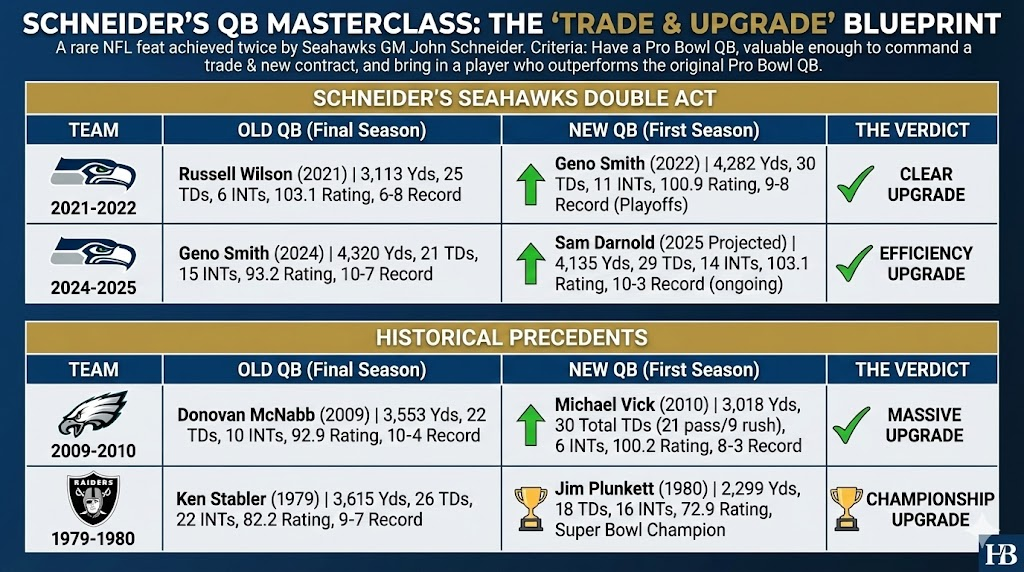
In the NFL, finding a franchise quarterback is difficult. Knowing exactly when to move on from one is nearly impossible.
The “perfect exit” is an art form: extract Pro Bowl production, sell high before the decline, secure trade assets, and immediately upgrade the position for cheaper. Even the infamous Deshaun Watson trade does not qualify as the Texans wandered the QB desert for two years before drafting C.J. Stroud. It is a sequence so difficult to execute that research suggests it has happened only four times in NFL history.
Schneider is responsible for two of them.
The first was the Russell Wilson trade, a move now widely regarded as one of the greatest heists in sports executive history. Schneider sold a declining asset for a historic haul, getting younger and more flexible while Denver footed the bill.
Then, he did it again.
Geno Smith had resurrected his career in Seattle, earning two Pro Bowl nods and outplaying Wilson’s final Seahawks season. But when Smith demanded a contract north of $50 million with multi-year guarantees, Schneider didn’t blink. He saw a 35-year-old quarterback at his ceiling. When Carroll returned to the NFL with the Las Vegas Raiders, Schneider seized the opportunity, shipping Smith to his former mentor for a third-round pick.
Macdonald had been steadfast that the Seahawks wanted Smith back. New offensive coordinator, Klint Kubiak, spoke effusively about Smith at his initial press conference. It would have been tempting for many GMs to bend in order to make life easier for the coaching staff. Schneider had already been working on backup plans.
“He has a great like poise about him,” Macdonald said. “It was just like, okay, we’re going to pivot, and let’s go. I think John deserves a lot of credit for like kind of setting the temperature for the whole thing.”
That pivot was Sam Darnold.
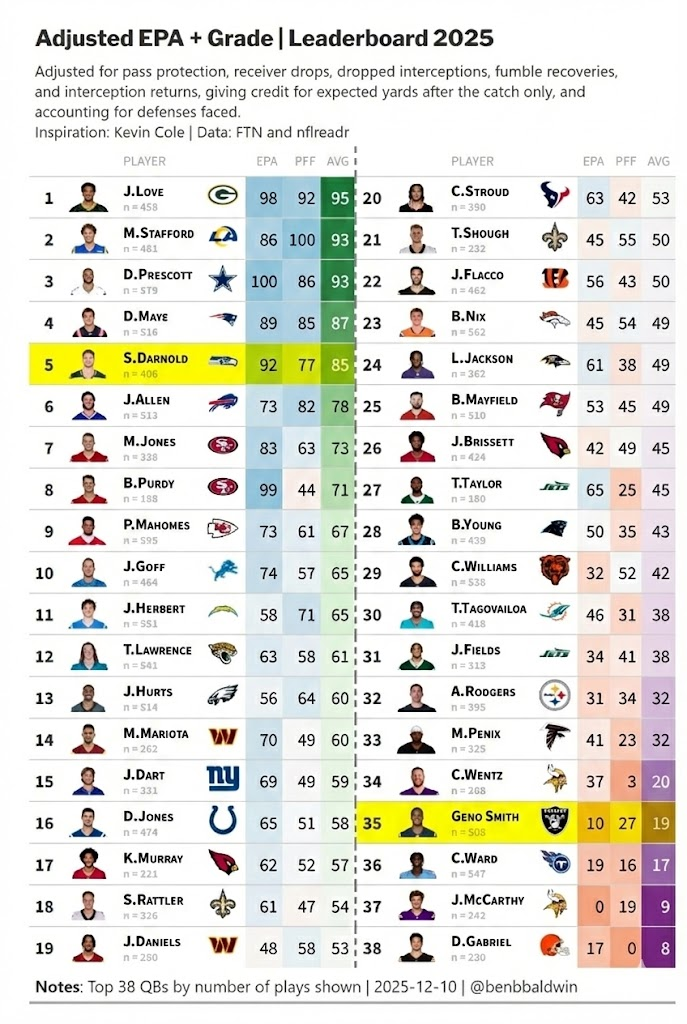
To the rest of the league, Darnold was a “buyer beware” candidate—a 27-year-old free agent despite winning 14 games and throwing 35 touchdowns for Minnesota the prior year. The Vikings had moved on to their drafted rookie, leaving Darnold in limbo. Schneider saw an arbitrage opportunity: a quarterback in his prime who fit the direction of the offense, the culture, and commanded a lower price than Smith.
The results have been historic. Darnold is now just the second quarterback in NFL history to win 10+ games in consecutive seasons for different teams. The only other player to do it? Tom Brady.
Ironically, reports suggest it was Brady—now part of the Raiders’ ownership group—who nixed signing Darnold in Vegas, preferring to trade for Smith instead. It was a costly miscalculation that Schneider happily exploited.
While questions remain about Darnold’s postseason ceiling, the verdict on the process is undeniable. Schneider has upgraded the most important position in sports twice in four years by selling high and buying smart.
“Bill Walsh was big on saying there’s a small percentage of people that have any clue what they’re doing when they look at a quarterback,” says former scout John Middlekauff. “I would say John’s track record now… feels pretty good.”
MacGyver was a show in the ’80s and ’90s that featured the most resourceful hero of all time. He would take normal household items and use them to create a trap or defuse a bomb. MacGruber was developed by Will Forte, of Saturday Night Live, to poke fun at MacGyver. MacGruber would also use common items to try and defuse a bomb, except he was never successful, blowing up everything and everyone.
Schneider faced an offseason that was going to require him to leverage every resource at his disposal to handle a series of massive transitions. He had to make decisions on his quarterback, his most athletically gifted receiver, his perennially problematic offensive line, and support his head coach in bringing aboard a new offensive coordinator and new scheme. One wrong move, and everything blows up. It was a MacGyver or MacGruber offseason, and analysts almost universally predicted the worst.
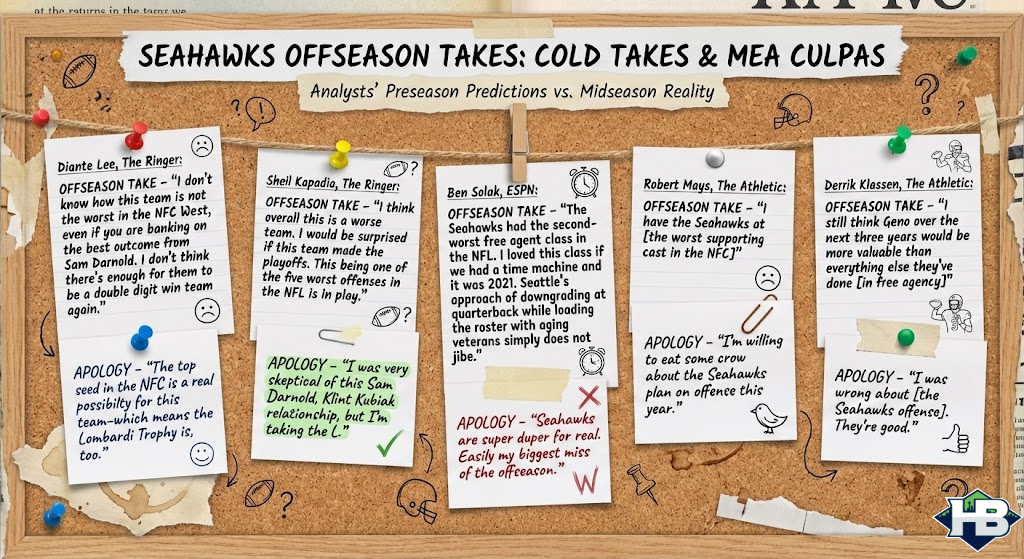
Schneider came under heavy fire for his decision to trade both Smith and D.K. Metcalf. The ensuing choices to sign Darnold fanned the flames. Darnold was seen as an inferior quarterback who would not have the same supporting cast or coaching that he had in Minnesota.
There was doubt outside Seattle that Jaxon Smith-Njigba could step into the primary receiver role, or even play outside of the slot. Many questioned whether the offensive line had been improved enough by just adding a rookie from a small school.
There was also skepticism about the addition of veteran defensive end DeMarcus Lawrence, who had missed most of last year with a foot injury and had contemplated retirement.
Vegas shared the skepticism. Seattle had a preseason over/under win total projection of 7.5 wins, behind teams like the Arizona Cardinals (8.5), Miami Dolphins (8.5), and Minnesota Vikings (8.5).
The critics were not only wrong on each count, but the degree to which Schneider proved to have the Midas touch was staggering.
Offensive Line Makeover
The Seahawks offensive line has been the butt of many jokes for over a decade. From 2015-2023, the Seahawks allowed 408 sacks, 3rd-most in the NFL, and a 7.9% sack rate, 2nd-highest in the NFL. Their coaching staff and front office have come under considerable fire for their lack of investment in the position, especially interior offensive line.
Mike Macdonald took over as coach in 2024, but the problems continued. Seattle ranked 24th in sack rate, adding another 50 sacks to their seemingly never-ending misery. Their starting center, Connor Williams, even retired over their bye week.
Macdonald fired their offensive coordinator, Ryan Grubb, after one season, citing philosophical differences that appeared to center around the lack of utilization of the run game and play-action. Kubiak was hired, and he brought veteran offensive line coach John Benton, along with Rick Dennison and Justin Outten.
Kubiak was clear this would be an outside zone running team with counters off of that, which included play-action and rollouts that moved the pocket.
Seattle went from 28th in run rate (37.2%) in 2024 to 1st in 2025 (51.1%). Their play-action rate rose from 29th (17.3%) last season to 10th (26.5%) through Week 12 in 2025. They also put heavy emphasis on under-center snaps, seeing their under-center rate more than double (23.2% to 55.6%) from the previous season.
Schneider was steadfast that the solution to the problem was not just personnel. Scheme, coaching, and development were crucial.
He went hard after free agent guard Will Fries, but lost out on him when he balked at taking a physical. That may have been a fortunate turn of events as it increased the priority of taking a guard in the draft, where they grabbed North Dakota State star, Grey Zabel.
Zabel was the first guard Seattle had used a Top 20 pick on since Hall of Famer Steve Hutchinson was taken 17th overall in the 2001 draft. He has become an immediate starter and the choice of some for Offensive Rookie of the Year.
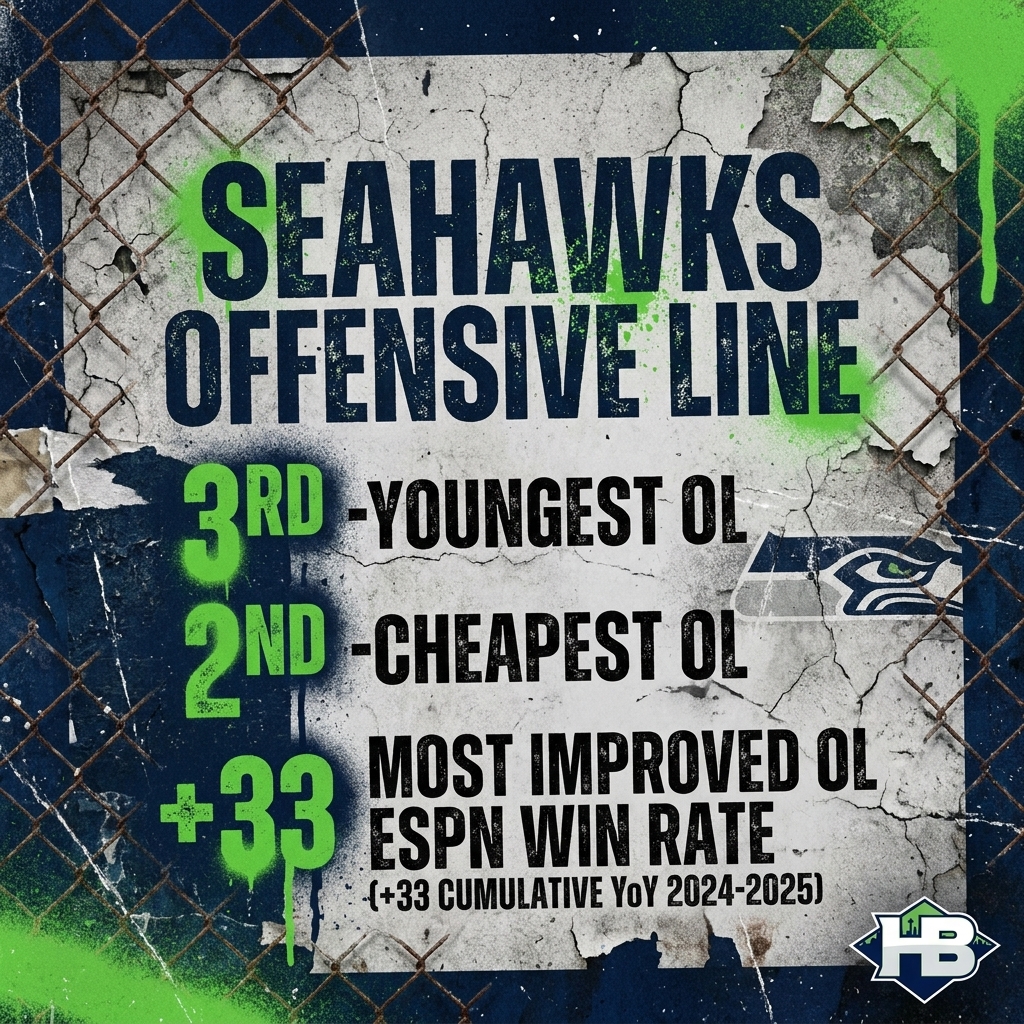
The high-risk path of relying on young players has led to a dramatic turnaround. Seattle entered Week 14 as the most improved offensive line by ESPN’s Pass Block and Run Block Win Rate metrics. Their sack rate has almost been cut in half from 8.3% to 4.5%.
Defensive Gems in Free Agency
Lost in the uproar was the Seahawks re-signing inside linebacker, Ernest Jones IV, to a 3-year, $28.5M contract and defensive tackle, Jarran Reed, to a 3-year, $22M deal. Those two moves ensured Seattle would return 10 of 11 starters from a defense that finished among the top five in a variety of measures over the final half of the 2024 season.
One of the challenges in the final years with Carroll had been a tendency to hold onto players and coaches too long. By contrast, Schneider’s willingness to trade both of the starting inside linebackers he had signed in 2024 (Tyrel Dodson, Jerome Baker) before the season ended dramatically accelerated the growth of Macdonald’s defense.
Jones had been acquired in one of those deals and had quickly become a leader and core part of the defense. It also gave Jones a chance to get to know his coaches and teammates and be open to making it a long-term arrangement. Seattle would have gone into the offseason unsure of who would fit at one of the most important positions on Macdonald’s defense had Schneider had any shred of ego about moving on from Dodson and Baker.
Stellar Draft
Many of the critics also missed the draft capital that Schneider had acquired in trading Smith and Metcalf. Seattle entered the draft with two picks in the 2nd round and two more in the 3rd round. That gave Schneider the flexibility to move around the draft board and acquire two different players they would have been happy to take with their 1st round selection.
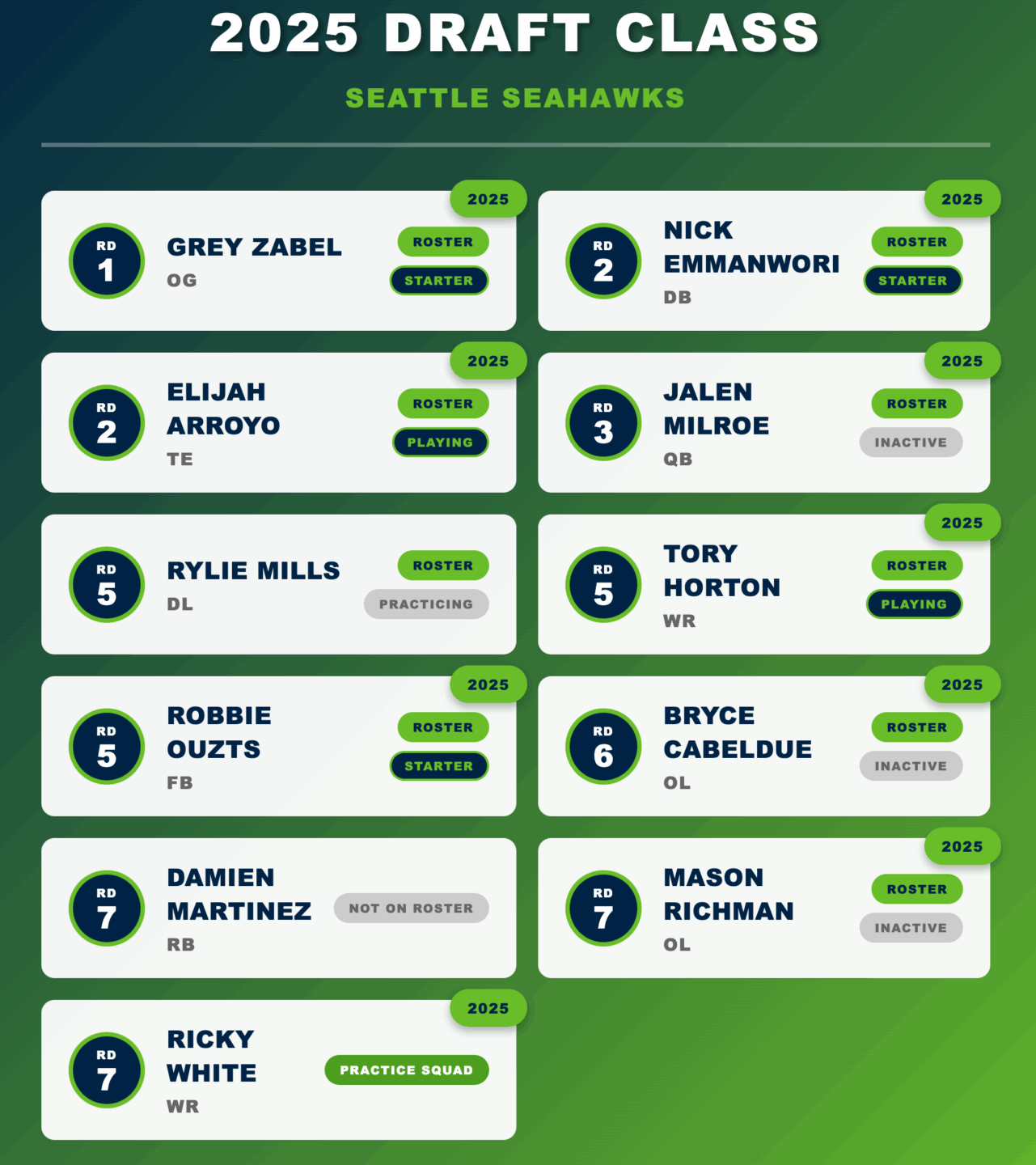
After picking Zabel, the team traded the 2nd-round pick they received from the Steelers for Metcalf to help move up and draft athletic hybrid defender, Nick Emmanwori. This was a position Seattle tried to address the previous year with Rayshawn Jenkins, but the extra year of collaboration between the scouting department and the coaching staff allowed them to dial in their target this time.
Matt Berry, Seahawks VP of Player Acquisition, noticed the difference this offseason.
“We know exactly what a Mike Macdonald edge [player] looks like and what it does not,” Berry said. “There is more specificity and less ambiguity. When you know what fits the role, it’s easier to find those players and you can be more pointed in your acquisition.”
The team got three more starters out of the draft, including tight end Elijah Arroyo, fullback Robbie Ouzts, and receiver Tory Horton. Horton was second among all rookies in touchdowns (6) after Week 9 before missing some time due to injury.
Former scout John Middlekauff, who has worked with great GMs like Howie Roseman, sees a direct tie between Schneider’s continued willingness to get his hands dirty with scouting to the quality of the personnel decisions he has made.
“Most of these GMs now tend to be more like corporate CEOs,” Middlekauff said. “Even guys that were from football backgrounds, like John, they’re in the office all the time, and they kind of get away from maybe their roots of going to schools and the scouting aspect. The amount of times over the last decades, that I have gotten selfies from my scouting buddies at a game with John Schneider watching Will Levis at Kentucky, or at the Oregon game, that is not normal. And no one’s holding you to that.”
Déjà vu?
Carroll and Schneider led a historic collection of talent in a shockingly short amount of time. They inherited one of the NFL’s oldest rosters, bereft of talent, and turned it into a Super Bowl winner by their fourth year. Schneider was new to the role. Carroll was not.
After a decade of meandering through mediocrity, Seattle is rising once again. Schneider now plays the role of seasoned veteran. Macdonald is roughly the same age Schneider was when he started his first GM job here. At the core of it all are a vision and principles that reflect humility and hard work.
The connection between the two men is the bedrock for what has become one of the most talented, tough, and connected locker rooms in the NFL. Defying convention and skeptics, Schneider has guided the organization through a minefield and toward another sustained stretch of championship-caliber football.
It has not gone unnoticed.
“There is probably not a guy that is more consistently highly thought of in the NFL with peers than John Schneider,” Middlekauff said. “People rave about how good he is at his job. And now it’s like, the proof is in the pudding. I mean, just watch his team play.”
On that emotional day in January, Pete Carroll offered a final, grinning warning to his successor: “You’re gonna find out, big fella.” And he was right. John Schneider did find out. He found out what it feels like when the “air cover” vanishes and the critics—from Vegas oddsmakers to national pundits—predict your collapse. He found out the weight of trading away his starting quarterback and the scrutiny of handing the keys to a rookie head coach.
But in navigating those minefields, Schneider found out something else. He discovered that a culture built on humility and connection can silence the noise. He found that his vision, executed in partnership with Mike Macdonald, could turn a rebuilding roster into a contender. Carroll warned him that he would find out how hard the job was. Schneider proved he was ready for the challenge. The rest of the league? They are the ones who are finding out.