

Week one of the NFL season is is misleading. The first Seahawks Super Bowl team in 2005 got walloped by the Jacksonville Jaguars to start that year. The first Seahawks team to win a ring needed a miraculous late touchdown pass to Jermaine Kearse to escape the Carolina Panthers, 12-7. Neither game was a good measure of the quality of those squads. It would be a mistake, though, to wave away the concerns that resurfaced in this consequential 17-13 loss to rival San Francisco. Part of the hope building for this team during preseason was the idea that old narratives would be challenged and outside skeptics would look foolish. Instead, this performance reinforced most the flaws that have been raised about this team’s construction, and added a few more.
The nuts and bolts of this game were pretty simple. Seattle’s offense was anemic. The 49ers offense was not much better (5.3 yards per play versus 4.6 for Seattle). Brock Purdy was the better quarterback and Kyle Shanahan was the better offensive play caller. That especially showed up on 3rd downs where the 49ers converted 50% of their tries (7-14), compared to 30% (3-10) for the Seahawks, including the game-winning touchdown. There have been years when Seahawks fans would have taken a moral victory out of having clearly closed the gap with the bully 49er crew. There were simply too many familiar flaws that left most frustrated, and some smugly wagging their “told you so” finger.
Consider some key points of disagreement entering this season.
The optimists
The belief was that Mike Macdonald had finally found his offensive counterpart in Klint Kubiak and that the offense would commit to the run in a way they never did last season. The young offensive line would be worlds better than any of the recent products due to health, talent, experienced coaching, and scheme. Ken Walker III and Zach Charbonnet would form a powerful and explosive due who would run behind battering ram fullback Robbie Ouzts and quality group of blocking tight ends and receivers.
There would be plentiful under center snaps with play action that made runs and passes indistinguishable. The receiving room would be talented enough to take on a supporting role behind the run game for occasional chunk plays with some veteran presence in Cooper Kupp who could make some key 3rd down and red zone plays. Tory Horton Jr. and Elijah Arroyo would burst onto the scene as productive rookies. Sam Darnold would run the offense efficiently, and cut down on some of his sacks by getting rid of the ball more quickly.
The defense would take a step forward in their second season under Macdonald, with more players joining Leonard Williams as dominant playmakers. DeMarcus Lawrence would help a first down weakness from last year and be a still-productive run defender while the other young edge players in Boye Mafe and Derick Hall would take their next step as pass rushers. Byron Murphy II would emerge as a more disruptive presence in the middle of the line. Nick Emmanwori would allow Macdonald to play a larger nickel package and deploy Devon Witherspoon in new ways.
Macdonald’s resume of giving NFC West offenses trouble would become a possible division-altering storyline.
The pessimists
Seattle downgraded at quarterback and wide receiver and brought in a mediocre offensive coordinator who will not be able to lift a team without playmakers. The offensive line will still be one of the worst in football. Opponents will stack the box to take away the run and dare Darnold and a subpar receiving room to beat them. Only JSN will be a weapon in the passing game. Kupp is washed and Horton is a 5th round rookie. The tight ends are nothing special. Darnold will shrink under pressure and in the big moments.
The defense will be good, but not great. Edge rush will be a problem and Murphy won’t be much more than he was a season ago. Emmanwori will struggle as a rookie. Riq Woolen will continue to make key mistakes. There may also be some issues at inside linebacker outside of Ernest Jones IV.
Macdonald will do a good job coaching the defense but still does not have a good offensive philosophy, and the team will be too limited on that side of the ball to be a quality playoff performer.
Early evidence
The Seahawks run game was the most important aspect of this football team heading into the season. I have said repeatedly that they need to be a Top 10 rushing offense to be a good team. The one aspect of that projection that seemed safe was that Seattle would commit to the run after suffering through Ryan Grubb’s pass-happy play calling a year ago. In some ways, that proved absolutely true. Seattle had the second-highest early down run rate in the NFL (pending MNF).
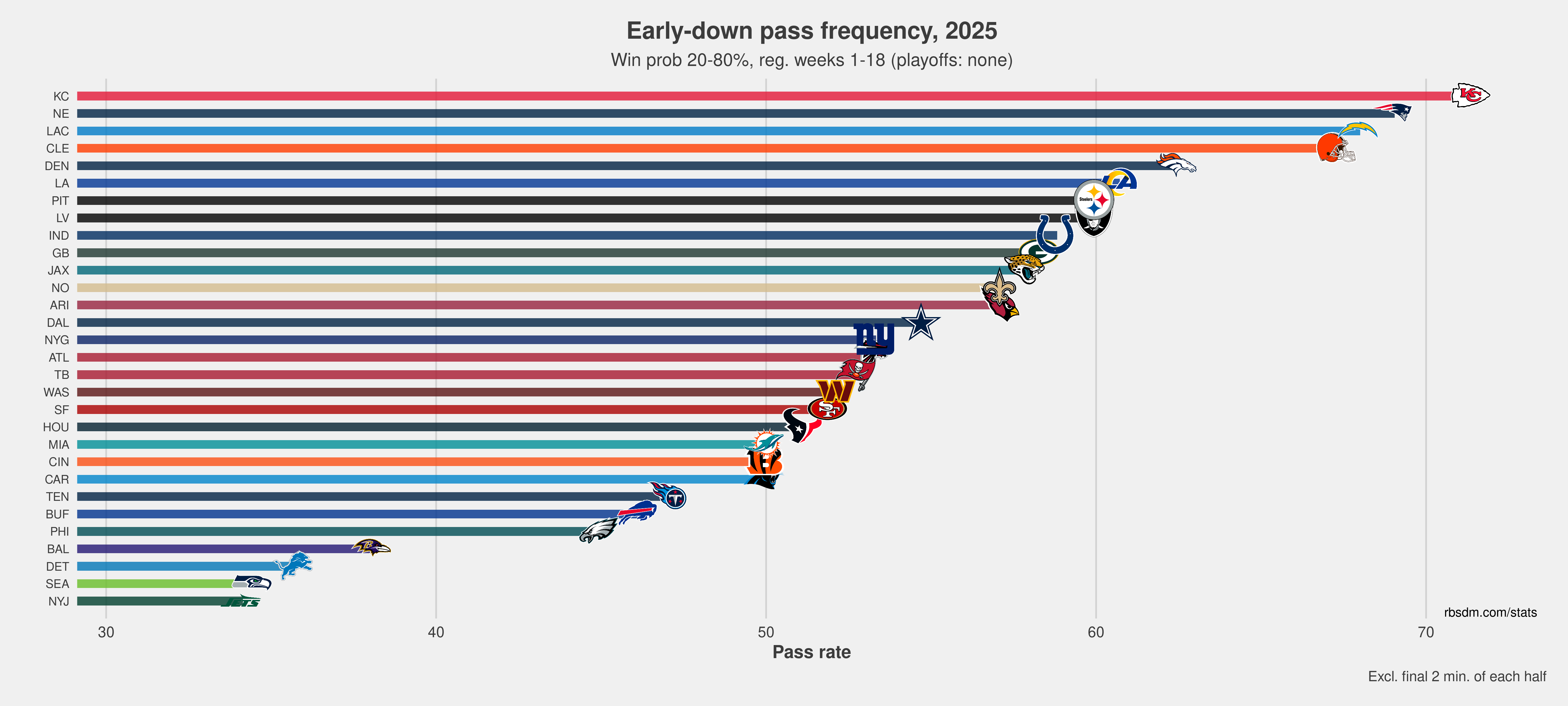
In other ways, it felt like a departure from the under-center, wide zone, play action, identity they practiced and preached all offseason. Seattle ranked 19th in the NFL in run outside the tackles (50%), per Next Gen Stats. More alarmingly, they were dead last in play action rate (4.2%), with just a single recorded play action pass attempt. That one attempt was a 21-yard completion, leaving Seattle with the second-highest EPA per dropback on play action passes in the league.
Their quick passing game was horribly ineffective. Kubiak dialed up screen passes that seemed more likely to lose yards than gain them. In fact, Seattle is currently dead last in the NFL in EPA/DB on quick passes (under 2.5 seconds) at -0.73. You can read that as Seattle lost nearly a point per play (estimated) when running quick passes. That problem gets worse when you realize quick passes made up 54% of their pass attempts.
The 49ers run defense was awful last year. The personnel changes they made to their interior line were limited to rookies. Robert Saleh, however, showed why he is considered one of the best defensive coaches out there by outclassing Kubiak all day. His ability to limit the effectiveness of the run game, while suffocating the quick game, left Kubiak grasping at straws.
It was bizarre to see Kubiak get away from the under center game as much as he did. It wasn’t until the penultimate drive to take the lead that they truly committed to that style. On that drive, they had runs of 8, 5, 7, and 4 yards before having a -1 yard carry. They did not see a 3rd down until they had already moved into field goal range. Where was this the rest of the game?
Macdonald talks about wanting to “throw their fastballs,” by which he means doing what they do best. It felt like they were messing around with secondary pitches all day, and wound up losing a game where they did not honor their intended identity on offense.
Walker had a particularly unproductive day that will only increase the calls for Charbonnet to take over the bulk of the carries.
There are some odd takes out there that this game proved Darnold was a fraud last season, and using this game as a chance to relitigate the decision to move on from Geno Smith. That conversation will continue all season (and maybe beyond), but feels like wasted breath.
Darnold was actually a wildly different quarterback in this game than he was a season ago. His time to pass was 2.59 seconds, 8th-fastest in the NFL so far. That number was 3.08 seconds last season, 3rd-slowest in the league. As previously mentioned, his shotgun rate was higher and his play action rate was way lower.
One commonality between last season and this one was that Darnold remained a productive deep passer. He ranks 9th in EPA/DB on throws over 20 yards. The problem is that he had just two attempts.
He seemed on the precipice of continuing another trend from last season where he was the top-rated passer in close and late situations until the fateful fumble that lost the game. He finished with 0 turnover-worthy throws, per PFF.
Generally, this game felt far more like an indictment on the Kubiak game plan and play calling than it did on Darnold.
The offensive line played reasonably well. When not blitzed, the Seahawks had the 3rd-best pressure rate in the league (17.6%). You might think that is completely related to the quick passing game, but they were still 15th in the NFL on pass plays that took over 2.5 seconds. Where they struggled was when the 49ers blitzed.
Seattle gave up pressure on 71.4% of pass attempts when Saleh called a blitz. That was the 5th-worst rate in the league. Overall, they wind up in the middle of the pack (16th) in pressure rate after this game.
Run blocking was probably a little better than it looked given how many players the 49ers were committing to the run. Seattle averaged 1.15 yards before contact, 16th in the league. They did that against stacked boxes on nearly a quarter of their rush attempts (23.1%).
Nick Bosa was a handful, as always, but only had 2 pressures on the day. Unfortunately, one of them winds up counting as a sack as he drove Abe Lucas back close enough to Darnold to cause the ball to slip out of the quarterback’s hands.
The bigger factors were guys like Kalia Davis and Jordan Elliott, who were far more stout in the middle than expected.
Overall, the offense was about what you would expect from a new coordinator, quarterback, and receiving room in the first game of the year. The hope was that they would burst onto the scene as a surprise group, led by a dominant run game. That did not happen. Most of the credit there goes to Saleh, but some of the blame certainly goes to Kubiak.
Defensively, the group looked a lot like they did over the last half of 2024. They were sound and tough. Purdy was under pressure on over 60% of his dropbacks, which was a career-high and ranks tops in the NFL so far. The 49ers struggled with the blitz even more than the Seahawks, giving up a league-worst 83.3% pressure rate when Macdonald blitzed.
Coverage was mostly excellent, allowing the 3rd-lowest average separation (2.9 yards) in the NFL. The problems, though, were all-too-familiar.
Riq Woolen was in position to be the hero twice on the game-winning drive for San Francisco. Twice, he was the goat. Purdy had already thrown two interceptions when he lofted a pass to Ricky Pearsall down the left sideline. Woolen was in great position to pick off another pass but misjudged the ball and allowed Pearsall to separate and make the biggest gain of the day. Later, Purdy threw up a desperation pass to little-used tight end Jake Tonges that should have been, at worst, knocked down by Woolen. Instead, Woolen did not attack the ball and Tonges surged in front of him to catch the game-winner.
This happened to Woolen against the Rams last year. It happened against the Vikings. He has the talent to be one of the best corners in the game, but failing to make the play in the biggest moments will limit his value.
The loss of Emmanwori early to an ankle sprain forced Ty Okada into the lineup and he was badly outplayed in his six snaps. So much so that he never returned to the field. It was clear Emmanwori was a big part of the game plan against the 49ers, and Macdonald had to adjust in real time.
That he still limited Shanahan to 17 points for the second-straight game, and his players were able to pick off two more passes, is encouraging. Murphy was more disruptive in this game, if not dominant. His win rate on true pass sets (16.7%) was similar to what he did last year (20.7%), while getting more chances. He had 13 snaps in those situations in this game, which would work out to 221 over a season. He had just 85 of those chances last year. If he can have a win rate that high while his volume of opportunities rises, he may still become the weapon the fans and teams envision.
The edge rush felt too much like last year. Nobody was getting quick pressures, and sacks were hard to come by. Purdy extended plays and found success just often enough to win the game.
Jones was terrific. Jobe was terrific. Williams won the matchup with Trent Williams. Julian Love was great. Overall, this performance should have been enough to win. At the same time, it still felt like a defense made up of quality players, but lacking in truly dominant playmakers.
Rough way to start
Chalk up one for the pessimists. Seattle was unable to beat a weakened 49ers team who also lost key players in George Kittle and Jauan Jennings during the game. They controlled a lot of the game, but could not convert in key moments on either side of the ball. Losing this divisional game at home will absolutely haunt this team later in the season, just as the Rams loss at home did a season ago.
One thought that came up after this one was that while the 2022 draft class was stacked with impactful players in Charles Cross, Walker, Mafe, Woolen, Lucas and Coby Bryant, there is some question about whether that group can the core of a contending team. This 2025 class feels different in terms of makeup. Somewhere between optimism and pessimism is the idea that this group might be where the team needs to build around, which will take more time than one season. How much they step forward over the course of this year will reveal how quickly they can take on that responsibility.
Seattle has what may be an even tougher matchup this coming week at Pittsburgh, a team with better personnel on the front seven than San Francisco. The book is now out on this offense. Stack the box and stop the run. Double Smith-Njigba, and dare Darnold to beat you anywhere else. As Macdonald says, the best way to the other side is through, not around.
That will involve holding true to their under center, play action, identity. This was not the disastrous game we have seen against the 49ers in the past. It also was not the encouraging step forward Seahawks fans were hoping to see. A surprise win on the road would go a long way toward getting back on track.